On September 1, 2026, UNEP-IEMP successfully co-hosted the annual international symposium on "The Path to Achieving the Kunming-Montreal Global Biodiversity Framework (GBF) Goals" in Beijing. The symposium, themed "National Reports and Process Prospects," was jointly organized by the Foreign Environmental Cooperation Center (FECO) of the Ministry of Ecology and Environment, the Chinese Academy of Forestry, the Committee on Biodiversity of the Chinese Academy of Sciences, the Natural Resources Defense Council (NRDC), the UNDP-GEF Migratory Flyway Network Project, and the UN Environment Programme–International Ecosystem Management Partnership (UNEP-IEMP). Representatives from government agencies, research institutions, enterprises, and non-governmental organizations worldwide gathered to exchange views and share insights on topics including "Progress in GBF Implementation and Biodiversity Mainstreaming," "Ecosystem Conservation and Restoration," and "Collaborative Efforts to Advance Biodiversity Protection."
Professor Zhang Linxiu, Director of UNEP-IEMP, moderated the first roundtable discussion. Distinguished panelists included Ms. Alla Aleksanyan, Director of the Department of Plant Diversity and Ecosystem Research at the International Scientific-Educational Center of the National Academy of Sciences of Armenia—the Presidency of COP17 to the Convention on Biological Diversity; Ms. Diana Pulido, Senior Coordinator for Cooperation and International Affairs at the Alexander von Humboldt Biological Resources Research Institute of Colombia—the Presidency of CBD COP16; Dr. Alice Stuart, Researcher at the Leverhulme Centre for Nature Recovery, University of Oxford; Dr. Julee Boan, Director of Partnerships for the International Boreal Forest Project at NRDC; and Ms. Wang Ye, Deputy Director of the Biodiversity Convention Division at FECO. They shared their observations, reflections, and expectations regarding the "Seventh National Report." Director Aleksanyan introduced that Armenia's National Biodiversity Strategy and Action Plan (NBSAP) has been aligned with the GBF, and the country is accelerating implementation, financing, and monitoring, aiming to demonstrate tangible conservation outcomes at COP17. Ms. Pulido noted that Colombia has already met its protected area coverage targets and is now shifting its focus from "expanding coverage" to "improving quality," employing multidimensional indicators to assess the effectiveness of protected area management. Dr. Stuart highlighted the work of UK scholars in conservation and monitoring technologies, emphasizing the need to address socioeconomic dimensions in conservation efforts. Dr. Boan discussed the unique challenges faced by Canada, the country with abundant biological resources in monitoring and protection, advocating for attention to crop security alongside conservation. Ms. Wang Ye presented China's approach of localizing the 23 GBF action targets into 27 national goals, with national reports jointly prepared through inter-ministerial collaboration. She underscored that the core strategy for conservation lies in mainstreaming biodiversity into the daily work and decision-making of all sectors. The panelists universally agreed that the success of biodiversity conservation hinges on cross-sectoral coordination and mainstreaming, rather than relying solely on dedicated funds or isolated initiatives.
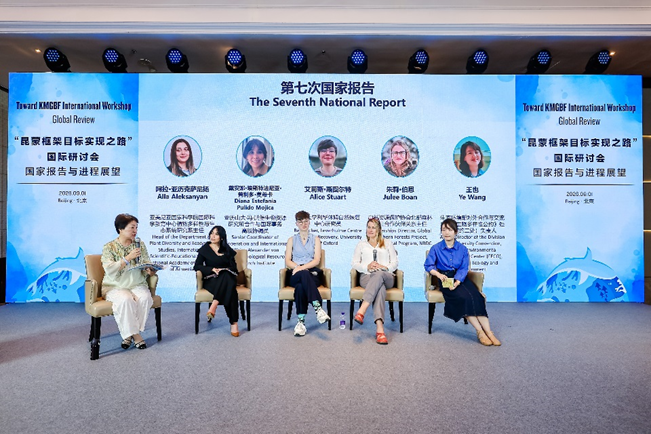
The scene of the first roundtable discussion
For more details on the symposium, please refer to related coverage.