Geneva, Switzerland, 27 May 2026 — At the GEO 2026 Symposium, the side event “EO-enabled MRV for Nature-based Solutions and Carbon Management” was successfully held. Bringing together stakeholders from across research institutions, national environmental authorities, international organizations, and the private sector, the event explored how EO applications—from carbon accounting and ecosystem restoration to forest monitoring, carbon markets, and climate finance—can move beyond technical capability to real-world impact. The event highlighted a growing shift from data-rich Earth Observation (EO) systems toward operational Earth Intelligence that can directly inform policy and implementation, and underscored the urgent need to bridge observation, socio-economic context, and decision-making.
Prof. Zhang Linxiu, Director of UNEP-IEMP, set the strategic tone in her keynote presentation, “Earth Intelligence for the SDGs: Linking Observation, Action and Impact.” She emphasized that the next frontier of EO lies not in improving data availability alone, but in integrating EO with socio-economic information to enhance the relevance, inclusiveness, and usability of decision-making processes. She highlighted that effective climate and ecosystem action requires answering critical questions beyond environmental change itself: who is affected, how livelihoods are impacted, and how development objectives can be aligned.
From a UNEP-IEMP perspective, this integration is essential to transforming EO into Earth Intelligence that serves sustainable development outcomes. Zhang further called on GEO to advance thematic pilot initiatives that combine observational, socio-economic, and policy data into coherent, decision-oriented solutions—moving from fragmented datasets to integrated systems that can guide national climate action and nature-based solutions at scale.
Supporting this vision, Prof. Chen Zhi, Director of the CERN Synthesis Center and Professor at the Institute of Geographic Sciences and Natural Resources Research, demonstrated how robust scientific infrastructure can underpin such integrated approaches. Presenting on behalf of the Chinese Ecosystem Research Network (CERN) and ChinaFLUX, she showcased China’s long-term ecosystem and carbon monitoring systems—including flux towers, ecological stations, remote sensing platforms, atmospheric modeling, and ground-based inventories—which together form a comprehensive multi-source data integration framework.
The event also showcased national-level case studies from Colombia and Gabon on natural resource and forest monitoring systems, as well as emerging applications of EO in supporting carbon markets and climate finance. These cases demonstrated that transitioning from isolated projects to national systems requires strong governance frameworks, capacity building, and sustained investment.
Participants widely agreed that the future of Earth Observation lies in advancing toward truly operational Earth Intelligence. Success should no longer be measured by the volume of data collected, but by whether information effectively supports real-world decision-making, credible carbon accounting, nature-based solutions, climate governance, and sustainable development financing. Achieving this will require scientific credibility, institutional ownership, system interoperability, sustainable financing, and strong cross-sector partnerships.
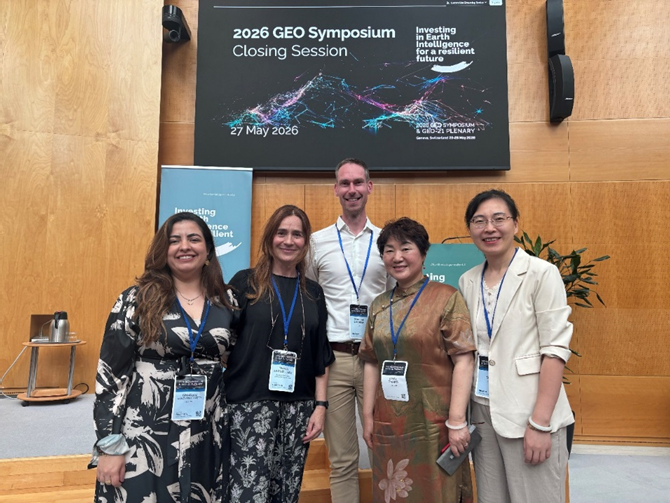
Group photo of participants