On July 20, 2026, the Secretary-General's Dialogue with Beneficiaries and Local Partners of UN Agencies in China was held in Kunming. Secretary-General António Guterres travelled to Kunming specifically to gain first-hand insight into the implementation outcomes of UN agencies Partnership Projects in Yunnan Province. The Dialogue was structured around three thematic pillars: biodiversity and climate change, rural revitalization, and gender equality. Nominated by UNEP China office, Community Agri-biodiversity Conservation Project jointly implemented by the Farmer Seed Network and the UN Environment Programme-International Ecosystem Management Partnership (UNEP-IEMP) was selected to participate in the dialogue. Ms. TIAN Milin of the Farmer Seed Network and Ms. ZHANG Xiuyun—a women’s representative from Shitoucheng Village, Baoshan Township, Yulong County, and board chair of the Baoshi Planting and Breeding Professional Cooperative on behalf of the project partners, attended the Dialogue together.
At the Dialogue, Zhang Xiuyun delivered a live presentation to Secretary-General Guterres, recounting the authentic story of how smallholder women farmers in China safeguard agricultural biodiversity. She stated "Seeds are not just food; they are also the wisdom passed down from our ancestors. We rural women are not only the custodians of seeds but also the hope of our communities, and contributors to global agri-biodiversity conservation." Secretary-General Guterres offered positive remarks on Yunnan’s practices in fostering harmonious coexistence between humanity and nature.
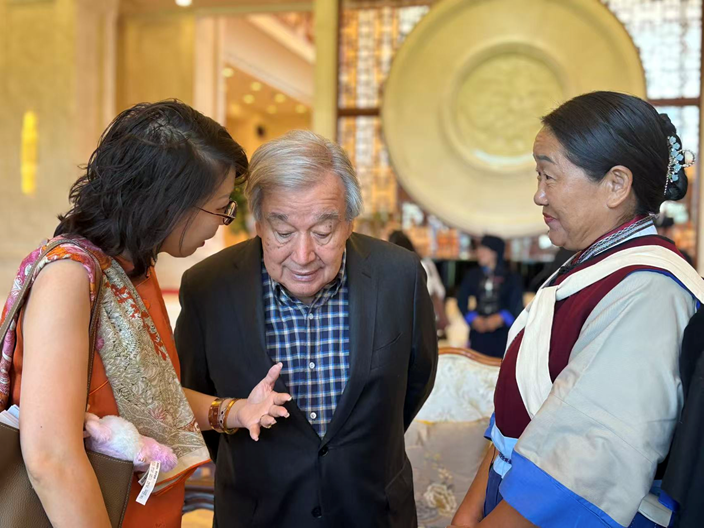
Ms. ZHANG Xiuyun communicated with Mr. Guterres
Perched atop a mushroom-shaped megalith in the Jinsha River gorge, Shitoucheng Village is a traditional Naxi settlement with a history of over 1,300 years. In 2013, the Farmer Seed Network introduced ecosystem-based conservation approaches—including participatory plant breeding and community seed banks—into Shitoucheng, supporting local farming households, particularly women, in carrying out in situ conservation of agricultural biodiversity. Subsequently, with the joining of UNEP-IEMP, partners have continuously accompanied Shitoucheng’s growth, helping community champions "go global" to learn from international experience, while also facilitating the sharing of Shitoucheng’s conservation practices in international fora.
The village has established a participatory core group and set up two community seed banks, which have collected and preserved 228 traditional landraces. With technical backing from plant breeders, Zhang Xiuyun successfully developed three new maize varieties based on heritage seeds. In 2018, she led village women to register an ecological farming cooperative, creating the "Baoshi" brand and transforming traditional farming knowledge into sustainable livelihoods.
With sustained support and facilitation from its partners, Shitoucheng’s experience has gradually extended to multiple communities across the Jinsha River basin. In 2016, initiated by Mu Wenchuan—head of Shitoucheng’s participatory core group—four Naxi and Mosuo villages within the basin voluntarily formed the "Naxi Mountain Communities Network," establishing a cross-community platform for cooperation, mutual assistance, and learning. This network has since evolved into an inter-community exchange and collaboration platform, and with the support of external partners, has participated in numerous domestic and international exchanges. In 2021, Shitoucheng’s approach to conserving and utilizing traditional landraces was selected as a "Biodiversity 100+ Global Typical Case." In 2024, the Shitoucheng Traditional Mountain Agro-ecological Farming System was recognized as a China Potential Typical Case for OECMs. Also, in 2024, the Naxi Mountain Communities Network was shortlisted as a finalist for the Equator Prize.
Looking ahead, the Naxi Mountain Communities Network will continue to deepen community-led conservation and sustainable use of agri-biodiversity, joining hands with more communities and diverse partners to strengthen local biodiversity conservation and knowledge-sharing. It will redouble its efforts to bring smallholder farmers and women into the fold of international exchanges and cooperation, so that community voices and resilience may find their place in the grand global endeavor of biodiversity conservation.