A UNEP-IEMP project team led by Programme Manager Ms. Wang Guoqin, conducted a productive field mission in Kenya for the project “Ecosystem Restoration for Enhancing Livelihoods and Addressing Climate Change: China-Kenya Cooperation on Bamboo Technology Transfer” during July 30-Aug 7, 2026.
Together with the project’s local implementing partners, the Jaramogi Oginga Odinga University of Science and Technology and the Sango Bamboo Association, field assessments on bamboo agroforestry and riverbank restoration in Nzoia River Basin identified key achievements, lessons learnt, opportunities and challenges. Continued joint plans combining bamboo nursery, riverbank stabilization with multiple species, short- and long-term intercropping systems, bamboo home garden, and sustainable plantation maintenance were formulated for implementation.
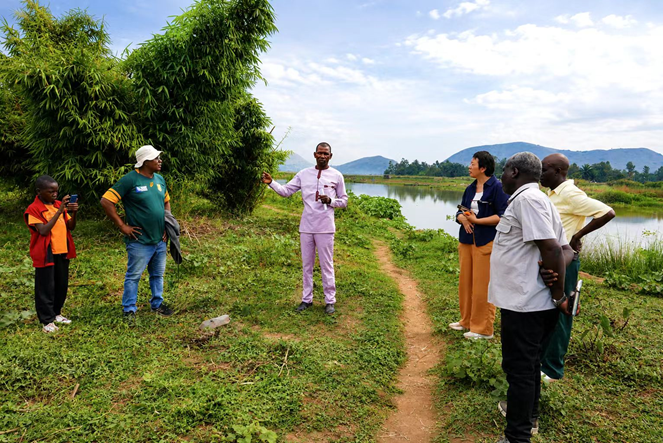
Field assessment of the riparian restoration progress in the lower reach of Nozia River Basin, Busia county
This joint mission also launched the first bamboo weaving training and production under the Sango Bamboo Association of Bunyala sub-county, Busia, at its given land and facility of the Constituency Industrial Development Center. Twenty-nine community members were enabled to produce bamboo strips from local bamboo forest and weaving productions for the tourism market. Through co-creating Kenya culture featured bamboo souvenir products, this training enables the Sango Bamboo Association and its members to generate income as alternative livelihoods.
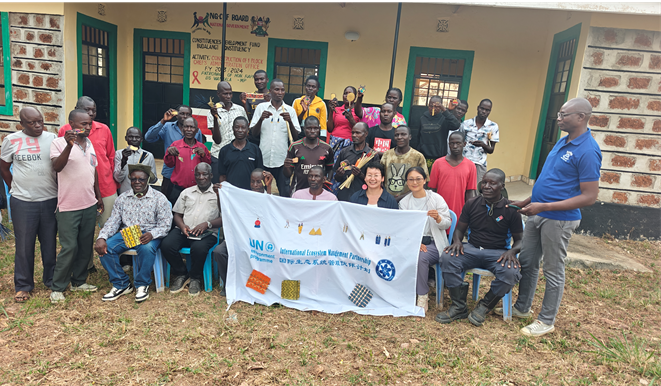
Bamboo weaving training at the Sango Bamboo Association, Busia county
The team also delivered full-cycle bamboo weaving training at Nairobi and Narok counties, covering bamboo strip processing, handcraft carving and weaving techniques. Local partnership and Mara community engagement brought such souvenirs closer to tourism access. A local value chain integrating bamboo plantation, community-based bamboo handcraft production and hotel tourism sales was piloted through the project efforts.
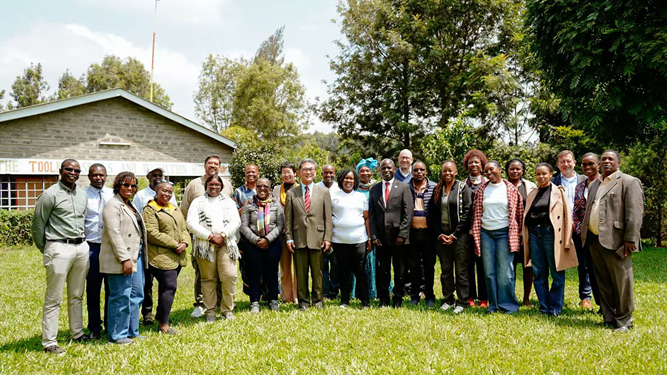
Group picture of the Exploring a Community-Led Bamboo Bioeconomy Dialogue, Nairobi
In Nairobi, the delegation held stakeholder consultations with Kenya’s Ministry of Agriculture, Ministry of Environment, African Development Bank, World Bank, World Resource Institute Africa, Bamboo Innovation Center Africa, Habitat for Humanity International, Dream Building Welfare Association, Lazizi Welfare Foundation and ForumCiv. Those stakeholder consultations covered the topics of long-term direction and financing for bamboo value chain in Kenya, bamboo agroforestry scaling-up, eco-bamboo housing demonstration, bamboo weaving for tourism market and watershed restoration collaboration.
This field mission facilitated more community groups, interested stakeholders and donors to engage in bamboo value chain development in Kenya. Such enhanced Kenya-China bamboo cooperation will advance degraded land restoration, local green jobs and climate resilience in tandem.