From 11 to 15 October 2026, Ms. Linxiu Zhang, Director of UNEP-IEMP, and Mr. Chao Fu, Head of Research Unit at UNEP-IEMP, visited Rome, Italy, and participated in the Rome Water Dialogue of the 2026 World Food Forum at the headquarters of the Food and Agriculture Organization of the United Nations (FAO). As an important component of the Forum, the Rome Water Dialogue provides a global platform dedicated to advancing Integrated Water Resources Management to strengthen food and water security worldwide, promoting an integrated approach that connects water, land and soil management. The main purpose of this visit was to showcase the latest outcomes of the FAO–UNEP-IEMP collaborative case study on good practices in sustainable management and restoration of global agricultural lands, and to strengthen exchanges and cooperation with partners.
On 12 October, the team attended a technical session within the Rome Water Dialogue on “Restoration of degraded agricultural lands: Innovation from policy to practice for water and food security”. The session was organized by the FAO Land and Water Division, and was addressed by Ms. Beth Bechdol, Deputy Director-General of FAO, as well as ministerial-level agriculture officials from Kenya, Jordan, Kazakhstan, Russia and Central American Agricultural Council. During the panel discussion, Ms. Linxiu Zhang delivered a keynote presentation, in which she pre-launched and presented the findings of the Global Compendium of Practices in Sustainable Management and Restoration of Agricultural Lands and Soils (Volume 1: Rangelands, Pasturelands and Grasslands), jointly compiled by FAO and UNEP-IEMP.
The report selects 15 good cases from 61 cases solicited globally, covering good practices in pasture/grazing land management, agrosilvopastoral systems, soil and water restoration, and wildlife management across the world’s major grassland regions, including cases from China's Loess Plateau, Tibetan alpine grasslands, and Inner Mongolian arid and semi-arid grasslands. In her presentation, Ms. Zhang analysed the innovations of several outstanding cases in technological, institutional, social, policy and financial dimensions, and in particular, using the case of the synergistic "Energy–Ecology–Agriculture" development in Dalad Banner, Inner Mongolia of China, demonstrated the pathway through which new technology-based solutions can achieve multiple benefits. She also figured out the constraints and gaps that need to be addressed and the way forward for scaling up action. Subsequently, experts from Brazil, Spain, Mongolia and other countries shared their respective experiences and perspectives on how to strengthen the restoration and sustainable management of agricultural lands.
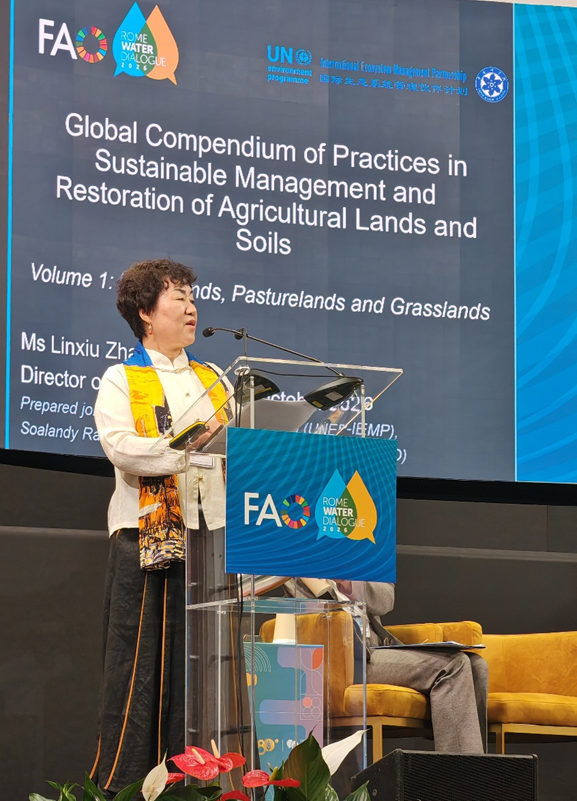
Keynote presentation at the technical session of Rome Water Dialogue
The team also participated in other technical sessions held on 12–13 October within the Rome Water Dialogue, including those on the governance of water tenure and on drought and irrigation management, as well as the Rome Water Dialogue Exhibition, and the High-level Rome Water Dialogue on held on the morning of 14 October. In addition, on the margins of the meetings, they held discussions with the FAO Sustainable Land Management team on the improvement and publication plan of the existing case study report, and exchanged views on the research framework and schedule for the next volume of case studies on croplands. This visit laid a solid foundation for smoothly advancing the existing collaborative project and for expanding partnerships and future areas of cooperation.