From October 24 to 25, the International Symposium on "2026 Renewable Energy Transition: Technology, Impacts, and Policy" was held at Beijing Normal University. The conference was co-hosted by Beijing Normal University, the UNEP-International Ecosystem Management Partnership (UNEP-IEMP), and the State Key Laboratory of Regional Environment and Sustainability. Top scholars and industry experts from China, the United Kingdom, South Africa, Thailand, Cambodia, Mongolia, and other countries and regions gathered to engage in dialogue on technological pathways, multidimensional impacts, and policy implications of the global green and low-carbon transition. Director Zhang Linxiu and Sun Mingxing attended the symposium.
Zhang Linxiu, Director of UNEP-IEMP and Co-Chair of the conference, attended the opening ceremony and delivered a speech. Director Zhang pointed out that the world is currently at a critical historical juncture of energy transition, with renewable energy accelerating its replacement of traditional fossil fuels. As developing countries are expected to account for the bulk of future global energy demand growth, their sustainable transition is of decisive significance for achieving global climate targets and the United Nations Sustainable Development Goals (SDGs). She emphasized that the energy transition should not be limited to a single engineering or power-sector perspective; rather, it must be deeply integrated with the health of natural ecosystems and the well-being of local communities. She highlighted the "Climate-Ecosystem- Livelihoods" (CEL) flagship of UNEP-IEMP, as well as South-South cooperation mechanisms, and called on all parties to leverage interdisciplinary synergy and extensive international cooperation to address the multiple challenges developing countries face in resources, technology, and finance, thereby effectively translating scientific understanding into policy impetus for a fair and sustainable energy future.
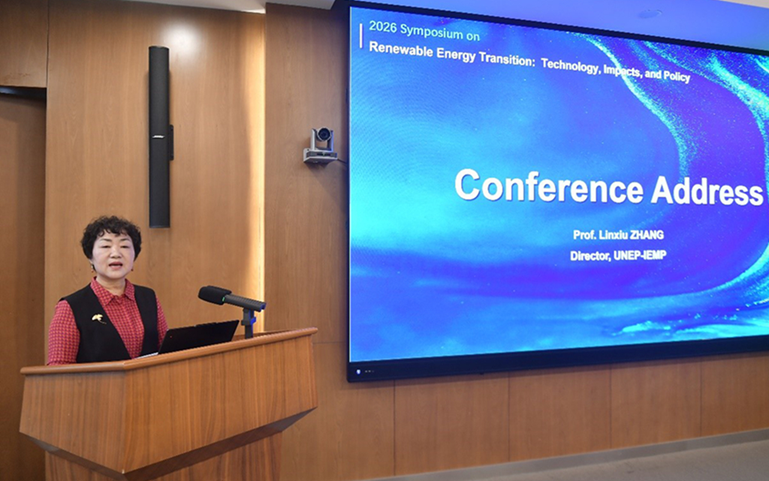
Director ZHANG Linxiu delivered an opening speech
During the two-day conference, participants engaged in enthusiastic and in-depth discussions focusing on core topics such as energy transition mechanisms and drivers, multidimensional environmental and resource impacts, socio-economic effects, and sustainable pathways. In the conference summary session, Director Zhang Linxiu delivered insightful remarks. She emphasized that energy transition is a complex, long-term systematic process that goes beyond mere technological innovation; it requires a comprehensive coordination of multidimensional impacts across environmental, economic, and social spheres, with particular attention to the profound social relations and impacts of new energy development on land tenure and property rights. She pointed out that researchers should strengthen science-based policy influence, bridging the channel from scientific discovery to policy translation. Meanwhile, upholding the philosophy of "Think Global, Act Local," we should actively leverage high-level international platforms such as the United Nations to showcase the innovative achievements and practical contributions of the Chinese and global scientific communities to the world.