From October 27 to 31, 2026, the Engineering Conference & the 6th International Symposium on Coastal Resources and Environment (CORE 2026) was held at Zhuhai Campus of Beijing Normal University. Centered on the theme “Empowering Resilience Enhancement and New-Quality Development of Large River Deltas with Artificial Intelligence”, the conference attracted around 200 experts and scholars from 13 countries. Prof. Zhang Linxiu, Director of the UN Environment Programme-International Ecosystem Management Partnership (UNEP-IEMP), was invited to deliver a plenary keynote presentation entitled Climate-Ecosystem-Livelihood Nexus: Advancing Agrifood Systems Resilience and Green Low-Carbon Transformation.
In the presentation, Prof. Zhang introduced the interconnected challenges of climate change, biodiversity loss and pollution, highlighting the Climate–Ecosystem–Livelihood (CEL) nexus approach to advancing agrifood systems transformation. Drawing on research and practical experience from China, other Asian countries and Africa, Prof. Zhang shared examples of reducing agricultural carbon emissions among smallholder farmers and developing ecological farming in China; improving rural diets; strengthening women’s participation in crop-choice decisions and agrobiodiversity in Asia; and linking community-led riparian restoration, agroforestry and bamboo value-chain development with local livelihoods in Kenya’s Lake Victoria region. She highlighted the importance of integrating agricultural development, ecosystem conservation and livelihood improvement. For mega river deltas facing increasingly complex climate and ecological risks, artificial intelligence and other digital technologies offer potential to support disaster early warning, water resource management and agricultural production. Their application, however, should be inclusive and sustainable to help advance agrifood systems resilience and the green low-carbon transformation.
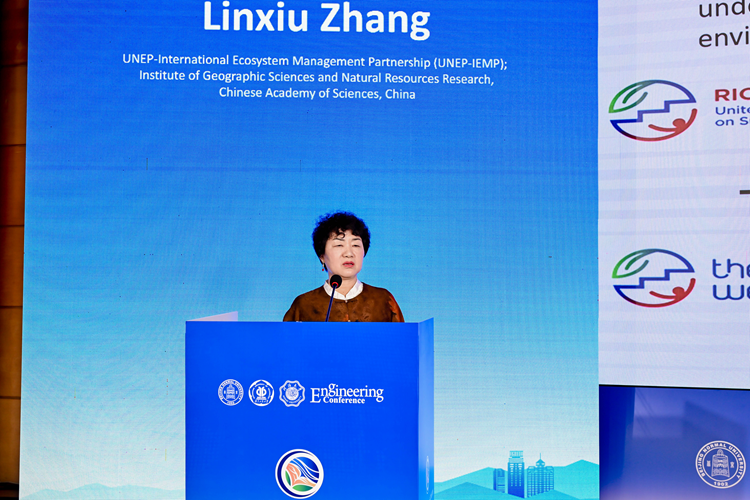
Director Linxiu Zhang delivered a plenary keynote speech